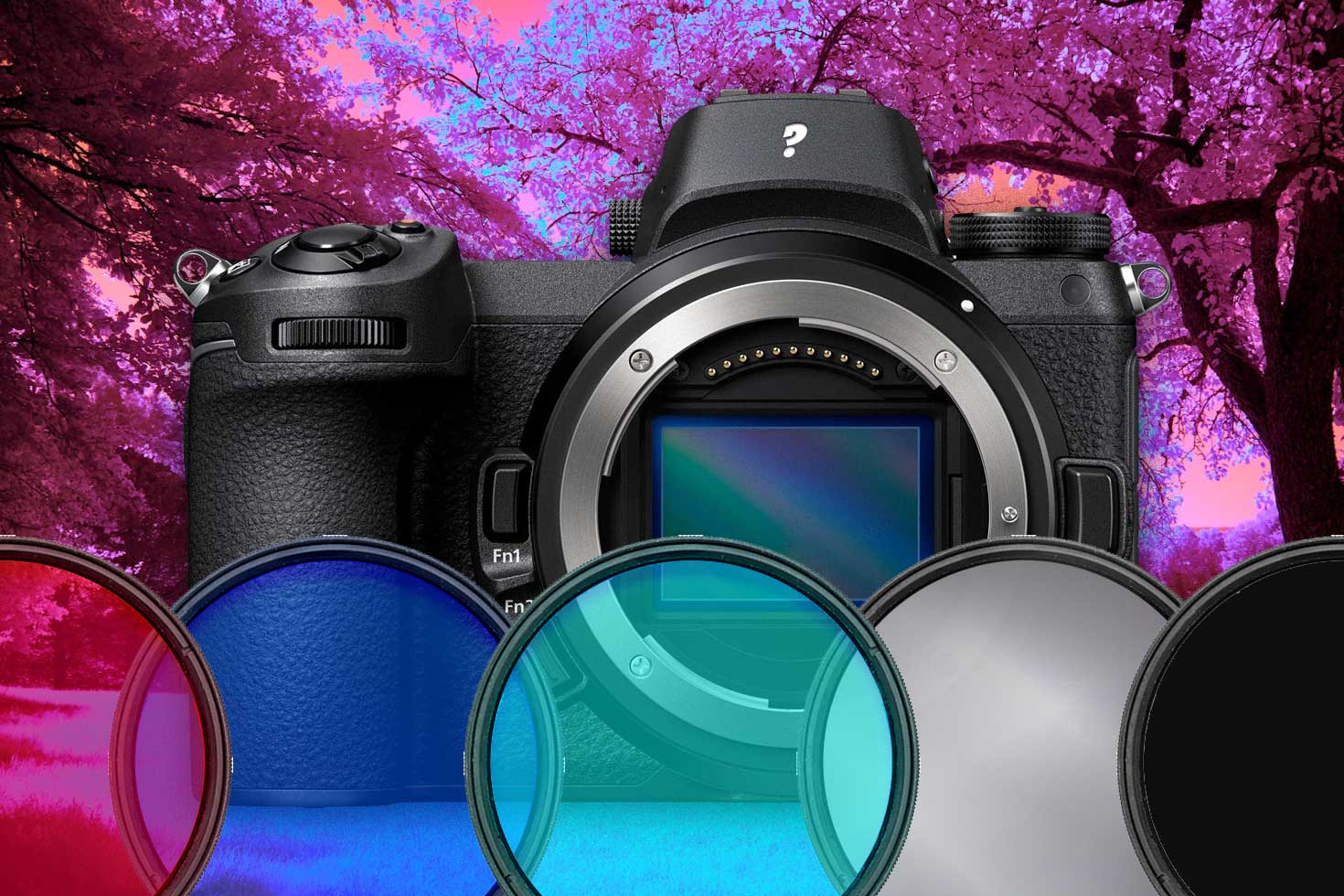
Once you have decided to take the plunge into infrared photography, you face a binary choice that will dictate your entire shooting experience: How should I modify my camera?
You essentially have two options: a Dedicated Conversion (where a specific IR filter is installed permanently over the sensor) or a Full Spectrum Conversion (where the camera is made sensitive to everything).
But within the “Full Spectrum” world, there is a second debate: do you put the filters on the lens or inside the body?
I have used all three methods extensively. Here is the reality of living with each, so you can decide which workflow fits your style.
Option 1: The Dedicated Conversion (720nm, 590nm, etc.)
In this modification, the technician removes the camera’s internal “hot mirror” (UV/IR blocker) and replaces it with a specific infrared glass filter, such as 720nm.
The Pros:
- Convenience: It behaves exactly like a normal camera. You grab it, turn it on, and shoot.
- Dust Protection: You never expose the sensor to the elements.
- Viewfinder Accuracy: On mirrorless cameras, the EVF shows you exactly what you are capturing.
The Cons:
- You are Married to the Look: If you convert to 720nm, you are stuck with 720nm. You cannot decide next week to try false-color 590nm photography without sending the camera back for a re-modification.
Option 2: Full Spectrum + Lens Filters
In a Full Spectrum conversion, the internal blocker is replaced with clear glass. The sensor sees UV, Visible, and IR light simultaneously. You control the light by screwing filters onto the front of your lens.
The Pros:
- Ultimate Versatility: You can shoot UV, Standard IR (720nm), False Color IR (590nm), or normal visible light (with a hot mirror filter) using a single camera body.
- Filter Stacking: This is a “power user” advantage. You can stack multiple filters to create custom spectral curves (more on this below).
The Cons:
- The “Filter Tax”: You must buy a filter for every lens diameter you own (67mm, 72mm, 77mm, etc.). This gets expensive.
- The “Lens Swap” Dance: Changing lenses is slow. You have to unscrew the IR filter from the old lens and move it to the new one.
Option 3: Full Spectrum + Clip-In Filters
This is the modern “Third Way.” A Clip-In filter sits inside the camera body, sandwiched between the sensor and the back of the lens.
The Pros:
- Lens Agnostic: One filter covers every lens you own. It solves the “Filter Tax” problem instantly.
- Unlock Exotic Lenses: You can shoot IR with lenses that don’t have front filter threads, such as ultra-wide fisheyes (e.g., the Nikon 16mm) or older vintage glass with weird thread sizes.
The Cons:
- Field Friction: changing a clip-in filter requires taking the lens off and poking around inside your camera sensor box. It is fiddly to do in the field and increases the risk of getting dust on your sensor.
- Incompatibility: Some lenses protrude too far into the body and will hit the filter.
The “Pro” Argument for Lens Filters: The Aerochrome Stack
While Clip-in filters save money, I still prefer using screw-in lens filters for one specific reason: Stacking.
Infrared photography is experimental. Sometimes the look you want doesn’t exist in a single filter. Currently, my favorite ‘Holy Grail’ look is the classic Kodak Aerochrome aesthetic (pink foliage, blue skies), achieved straight out of camera.
I achieve this by stacking two specific filters:
- A Yellow Filter (to control contrast and block blue light)
- A Blue Cooling Filter (specifically a KB-20 or 80B)
This combination creates a unique spectral transmission that mimics Aerochrome film. You simply cannot achieve this easily with clip-in filters (you can’t clip two in at once!), and you certainly can’t do it with a dedicated conversion. This freedom to mix-and-match glass is why the “old school” screw-in method remains superior for creative work. I explain this in greater detail in The ‘Holy Grail’ Filter Stack: How to Shoot Aerochrome In-Camera.
My Recommendation
If this is your first infrared camera, get a Full Spectrum conversion.
It gives you the freedom to experiment. Start with a couple of cheap screw-in filters (like a 720nm and a 590nm). As you grow, you might explore Clip-In filters for your wide-angle lenses, or start stacking glass to create your own signature look.