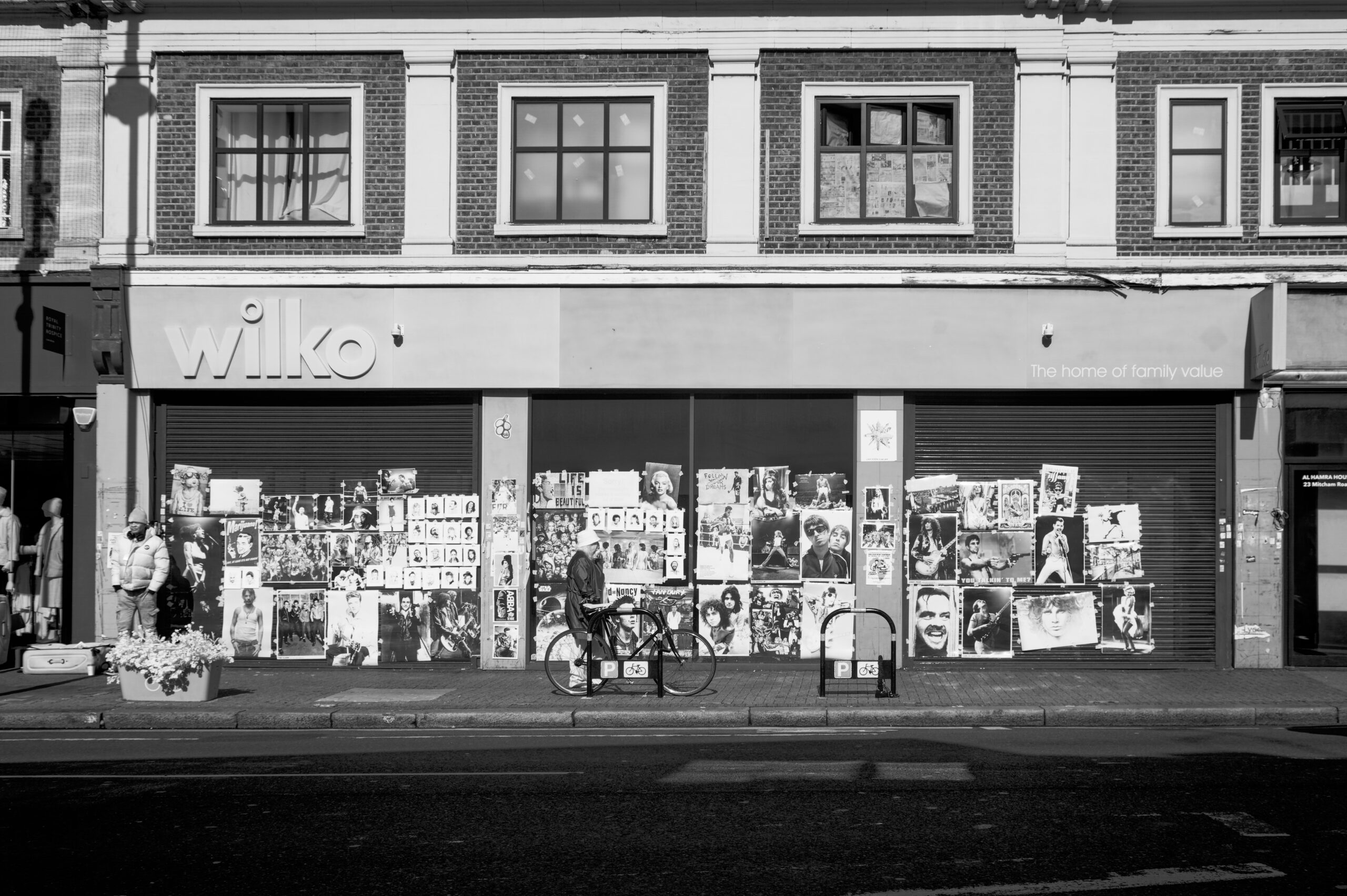
A poster seller in the street in Tooting Broadway, in London. Posters are taped up on the shuttered front of a Wilko store that is waiting for redevelopment.
Shooting infrared street photography is only really practical with a ‘full spectrum’ converted digital camera, specifically a mirrorless model rather than a DSLR. Shutter speeds are roughly as you’d expect with regular visible light, and with mirrorless cameras what you see in the viewfinder or rear screen is exactly what the sensor will capture.
This is another image shot with a 742nm IR cut filter, one that blocks all visible light (which is approximately 400-700nm) but lets very near infrared light through. More extreme IR cut filters in the 800nm or even 900nm range are available and can be very interesting to use, but results will be increasingly contrasty. (Digital camera sensors top out at around 1100nm, so you should regard filters at the 900nm range to be a practical extreme.)