
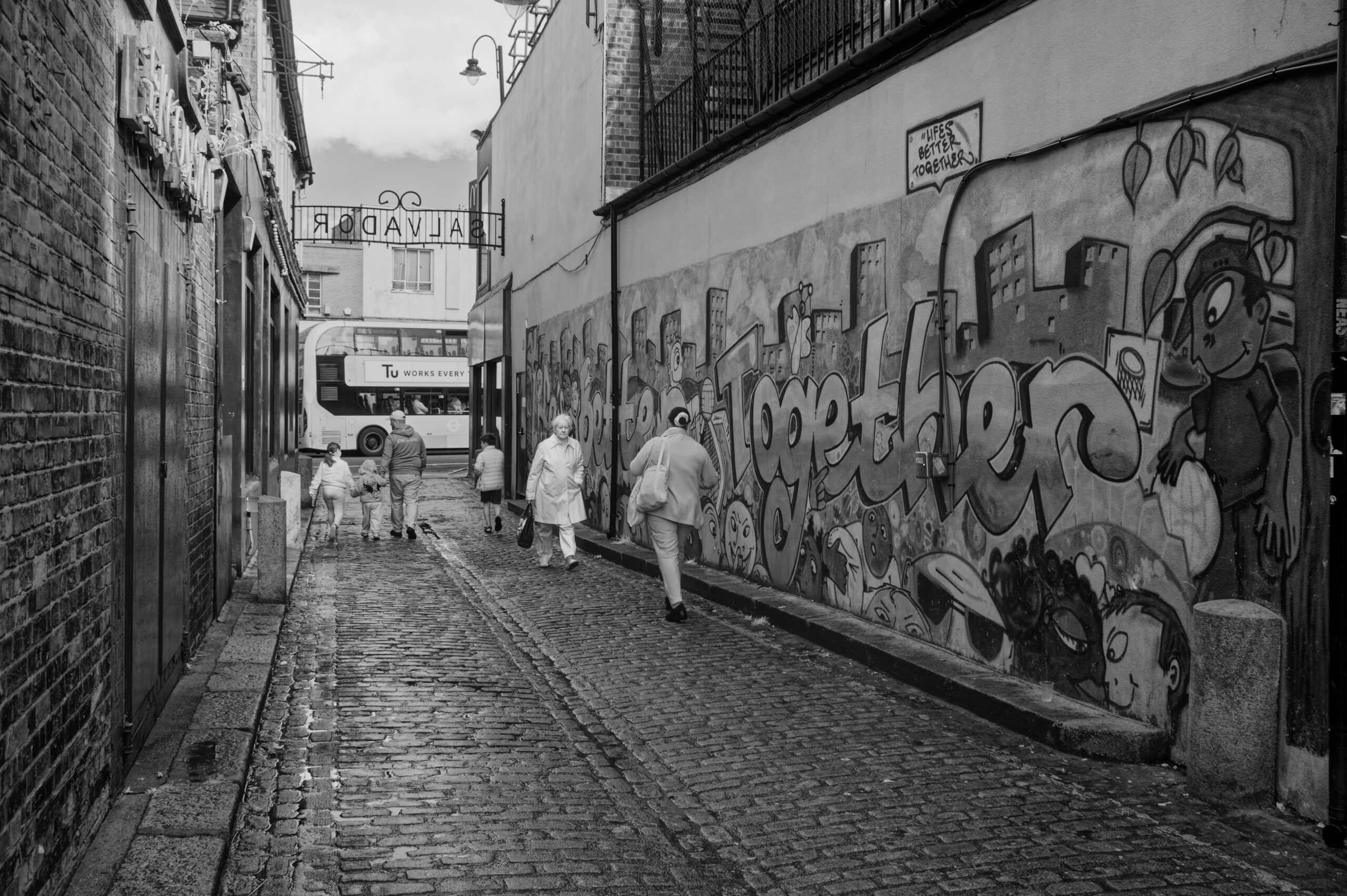
Cobbles used to be the main way streets were paved, an approach to road construction that arrived in Britain with the Romans. The results were highly durable but bumpy, and almost all of these have been replaced or covered over with tarmac. However, some small side streets and alleys around the country still have their original cobbled surfaces.
This is a cobbled alley off a main road going through Tooting Broadway in South London. The sign above the alley entrance reads “SALVADOR.” This refers to the alley’s name, either ‘Salvador Place’ or ‘Salvador Row,’ although in maps today it is just called ‘Salvador.’ The name comes from the Salvador family who owned a large country estate in the area in the 18th century.
This is a convenient cut-through between the high street and one entrance of a large Sainsbury’s supermarket and car park.
Shot using a 720nm IR-cut ‘clip’ filter, one that sits inside the camera body right in front of the sensor itself. This means any lens can be used without having to juggle different screw-on filters, and even lenses that don’t accept normal front-mounted filters can be used – as long as they don’t have ‘IR hot spots’ of course; see this article for more information about infrared and lenses.
The 720nm cutoff point of this filter means that no wavelengths below that level are transmitted to the sensor. As visible light ends at approximately 700nm, photos taken with this filter are captured using purely ‘invisible’ light.