
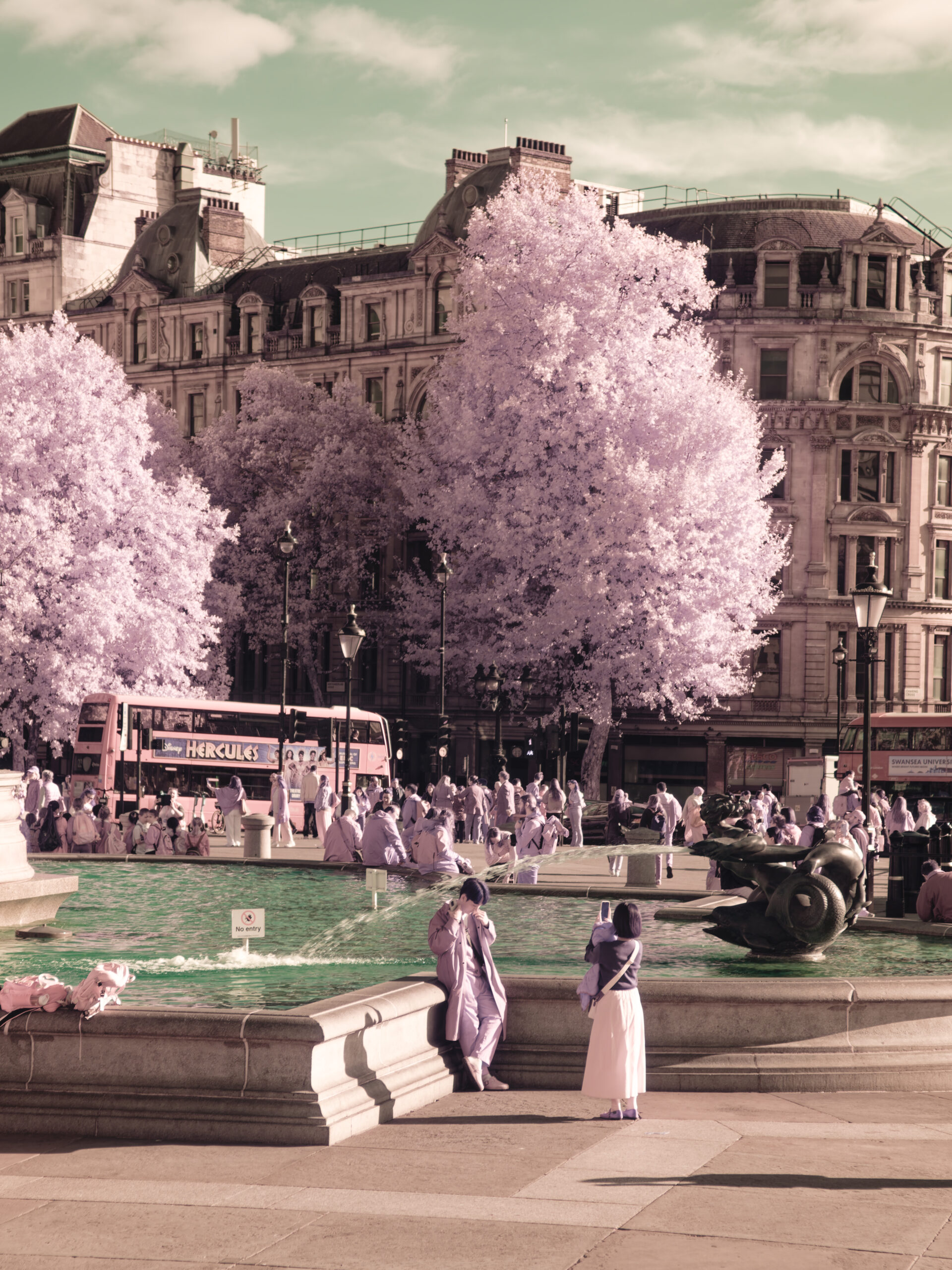
Tourists taking holiday snaps in Trafalgar Square, in central London.
An infrared photo created with a full-spectrum camera and filters (B+W KB-20, Yellow). This simulates the classic Kodak Aerochrome infrared colour film stock.
Like regular colour photography film, Aerochrome had three sensitised layers. But rather than recording red, green and blue as normal, Aerochrome maps infrared light to a red-producing dye. It records visible red, green and blue wavelengths in a particular way as well. Here’s the specific technical breakdown for the different wavelengths:
- Infrared light (~700nm and up) is translated as red in the final image
- Red light (~600-700nm) is translated as green
- Green light (~500-600nm) is translated as blue
- Blue light (~400-500) is also translated as blue
This is somewhat different to other kinds of infrared film stock behaviour. That typically either doesn’t capture any visible (RGB) light at all, or only captures in the red and a little of the green spectrum. Aerochrome’s unique characteristics and responses made it especially suitable for highlighting chlorophyll and distinguishing real vegetation from artificial camouflage. It was also extraordinarily effective in the hands of photographer-artists at rendering surreal ‘altered reality’ effects from scenes.
Kodak Aerochrome hasn’t been produced since 2009, and recreating its look has long been a goal of digital infrared photographers. This has typically been achieved through heavy post-processing, but this method is different! With the combination of a full-spectrum digital sensor and two specific filters – the B+W KB-20 and a yellow-green filter – we can achieve this straight out of camera! Yep, ‘SooC’ as the abbreviation goes, the holy grail for this kind of work. Okay, there’s a little optimising involved, but nothing more than you’d do to any regular colour shot as a general polishing stage.